
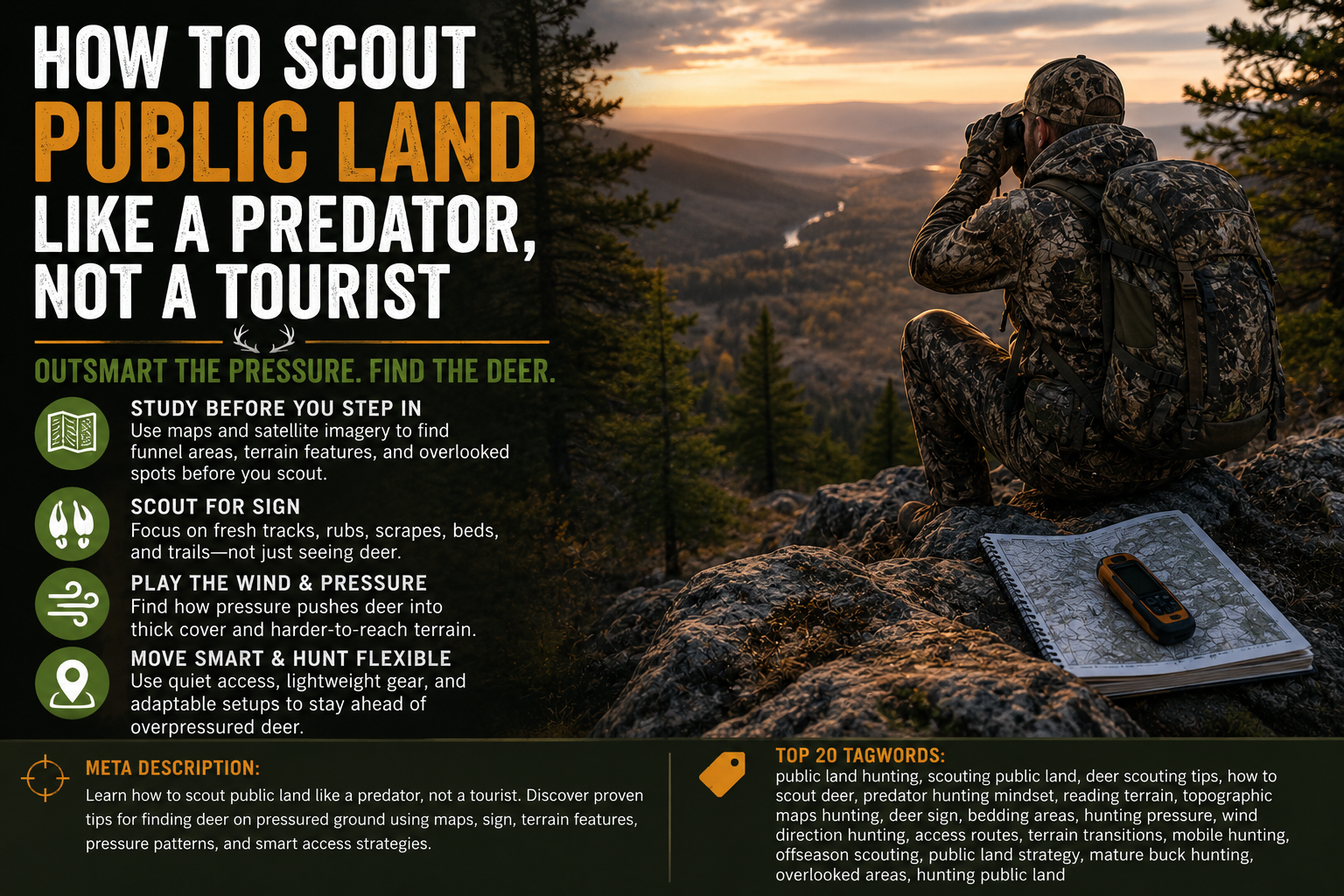
How to Scout Public Land Like a Predator, Not a Tourist
Public land deer hunting can intimidate beginners.
Competition, pressure, and unfamiliar terrain often make public ground seem difficult compared to private property.
Yet public land consistently produces mature bucks for hunters willing to scout intelligently.
The difference between successful public-land hunters and frustrated ones usually comes down to mindset.
Tourists wander randomly.
Predators analyze terrain strategically.
If you want to consistently find deer on pressured public land, you must learn to think differently.
Most Hunters Stay Comfortable
One of the biggest truths about public land is that many hunters avoid difficult terrain.
Most hunters prefer areas that are:
- Easy to access
- Close to parking
- Near trails
- Comfortable to walk
That means overlooked deer often survive in harder-to-reach areas.
Successful public-land hunters frequently target:
- Swamps
- Steep ridges
- Thick cover
- Remote creek bottoms
- Dense brush pockets
Distance alone does not guarantee success, but reduced pressure often improves odds dramatically.
Study Maps Before Entering the Woods
Modern mapping technology gives hunters enormous advantages.
Before scouting physically, study:
- Topographic maps
- Satellite imagery
- Property boundaries
- Terrain transitions
- Water sources
- Access points
Look for natural funnels and overlooked terrain features.
Key features often include:
- Saddle crossings
- Ridge points
- Creek crossings
- Marsh islands
- Thick cover near food
Digital scouting saves time and helps hunters avoid wandering aimlessly.
Scout for Sign, Not Just Deer
Many beginners walk through the woods hoping to physically see deer.
Instead, focus on finding evidence.
Important sign includes:
- Tracks
- Rubs
- Scrapes
- Trails
- Beds
- Droppings
- Browse lines
Fresh sign matters most.
A giant rub from last season means very little if no recent activity exists nearby.
Understand Pressure Patterns
Public-land deer react heavily to hunting pressure.
As pressure increases, deer shift toward:
- Thicker cover
- Lower-traffic areas
- Difficult terrain
- Nighttime movement
Mature bucks often position themselves where they can monitor hunter activity safely.
That means hunters should scout where pressure pushes deer, not where hunters prefer to sit.
Midday Scouting Can Reveal More
Many hunters scout early mornings or evenings.
However, midday scouting can be highly productive.
Deer are often bedded during midday hours, allowing hunters to identify:
- Bedding terrain
- Escape cover
- Nearby travel routes
Careful scouting during non-peak movement periods can reduce disturbance.
Learn to Identify Bedding Areas
Mature bucks survive because of smart bedding choices.
Good bedding areas often provide:
- Wind advantage
- Visibility
- Escape routes
- Thick cover
- Thermal protection
Examples include:
- Leeward ridge points
- Swamp edges
- Brushy knobs
- Cedar thickets
- Remote islands
Finding bedding areas dramatically improves hunting efficiency.
Scout Entry and Exit Routes
Many hunters ruin spots before the hunt even begins.
Predator-style scouting includes analyzing:
- Quiet access routes
- Wind-safe approaches
- Exit strategies after dark
Avoid crossing major trails or contaminating feeding areas.
The best stand location means little if access destroys the setup.
Hunt Terrain Transitions
Deer naturally travel edges and transitions.
Look for places where:
- Timber meets fields
- Hardwoods meet pines
- Thick cover meets open woods
- Elevation changes occur
These transition zones naturally funnel movement.
Scout During the Offseason
Post-season scouting is one of the best ways to learn public land.
After season ends, hunters can analyze:
- Beds
- Trails
- Rub lines
- Funnels
without worrying as much about disturbing current hunting patterns.
Winter scouting often reveals sign hidden by leaves earlier in the year.
Mobile Hunting Helps
Public-land success often requires flexibility.
Mobile setups allow hunters to adapt quickly based on fresh sign.
Lightweight climbing stands, hang-and-hunt systems, or saddle setups help hunters remain aggressive.
Static hunting rarely works consistently on pressured ground.
Avoid Hunting the Same Spot Repeatedly
Public-land deer learn quickly.
Repeated pressure near the same stand can educate mature bucks.
Rotate areas carefully.
Sometimes a location is best hunted only once under ideal conditions.
Learn from Other Hunters
Oddly enough, other hunters can help identify productive areas.
Pressure often reveals hidden deer movement.
For example:
- Heavy hunter traffic may push deer toward overlooked cover
- Parking patterns reveal popular access points
- Boot tracks show where hunters concentrate
Think about where deer escape pressure.
Wind Discipline Is Essential
Public-land bucks survive by using their noses.
Wind mistakes get punished quickly.
Always choose setups that keep scent away from likely deer movement.
Mental Toughness and Persistence
Public-land hunting requires patience.
You may scout multiple areas before finding consistent sign.
However, every scouting trip builds understanding.
The best public-land hunters think like predators:
- Analyze movement
- Anticipate pressure
- Understand terrain
- Adapt constantly
Final Thoughts
Public land offers incredible hunting opportunities for hunters willing to scout intelligently.
The key is separating yourself from average hunting pressure.
Tourists wander.
Predators study patterns.
By focusing on:
- Terrain
- Pressure
- Bedding cover
- Wind
- Access routes
- Fresh sign
hunters can consistently locate deer others overlook.
The beauty of public-land hunting is that success is earned through knowledge, effort, and adaptability.
For many hunters, that challenge is exactly what makes it so rewarding.